
O Ewigkeit, du Donnerwort (Bachkantate)
1918
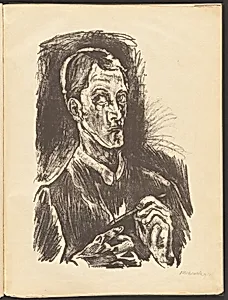
Medium
bound volume with twelve signed lithographs (eleven illustrations plus one illustrated titlepage of Fortuna) on laid paper.
Dimensions
sheet: 55 x 41.8 cm (21 5/8 x 16 7/16 in.) book: 56 x 42 x 1 cm (22 1/16 x 16 9/16 x 3/8 in.)
Classification
Volume
Department
CG-W
Museum
National Gallery of Art, Washington, D.C.
Credit
Gift of Beverly and Christopher With in memory of Karl and Gerda With
Accession Number
2008.96.1.2
Rights
Public Domain
Art Historical Context
Oskar Kokoschka’s 1918 volume *O Ewigkeit, du Donnerwort (Bachkantate)* brings together twelve signed lithographs that respond to Johann Sebastian Bach’s cantata of the same name. Produced as a bound book on laid paper, the work features eleven illustrations plus an illustrated title page depicting Fortuna. At a time when Kokoschka was already recognized as a leading voice in Expressionism, the portfolio demonstrates his ability to translate musical drama and existential themes into stark, emotionally charged imagery. The lithographic medium allowed Kokoschka to create bold contrasts and fluid, gestural lines that echo the cantata’s meditations on eternity and human frailty. Each print is individually signed, underscoring the artist’s direct involvement and the intimate scale of the project. Measuring roughly 56 by 42 centimeters when closed, the volume invites close, sequential viewing—much like turning the pages of a musical score. Acquired by the National Gallery of Art as a gift in memory of Karl and Gerda With, this artist’s book stands as a powerful example of early-twentieth-century printmaking that bridges music, literature, and visual art. Its creation in 1918 places it at a moment of profound cultural reflection, when artists sought new forms to express timeless questions about life and mortality.
About the Artist
Oskar Kokoschka · 1886–1980
Oskar Kokoschka (1886–1980) was an Austrian painter, graphic artist, and writer who became one of the foremost Expressionist artists of the twentieth century. Born in Pöchlarn, Austria, he studied at the Vienna School of Arts and Crafts, where he was influenced by Gustav Klimt and the Vienna Secession. His early works — including his play "Murderer, the Hope of Women" (1909) and his disturbing psy...