
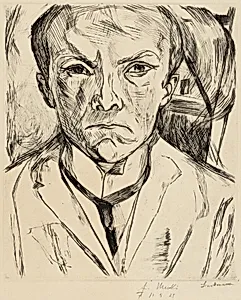
Self-Portrait
1918, published c. 1922
Medium
drypoint on wove paper
Dimensions
plate: 30.3 x 25.5 cm (11 15/16 x 10 1/16 in.) sheet: 51.8 x 38 cm (20 3/8 x 14 15/16 in.)
Classification
Department
CG-W
Museum
National Gallery of Art, Washington, D.C.
Credit
Gift of Mrs. Max Beckmann
Accession Number
1984.64.7
Rights
Public Domain
Art Historical Context
Max Beckmann's *Self-Portrait* (1918, published c. 1922) captures the artist's introspective gaze in a striking drypoint print on wove paper. Created at the close of World War I, this intimate work reflects Beckmann's turbulent era, as the German Expressionist grappled with the war's psychological scars—he served on the front lines and suffered a breakdown in 1918. Measuring 30.3 x 25.5 cm on the plate (51.8 x 38 cm sheet), its modest scale invites close viewing, emphasizing personal revelation over grandeur. Drypoint, Beckmann's chosen medium, involves scratching directly into a copper plate with a sharp needle, producing burrs that yield rich, velvety lines full of texture and immediacy. This technique suits his bold, distorted style, a hallmark of Expressionism, where angular forms and intense contrasts convey inner turmoil and existential depth. Unlike smoother etching lines, drypoint's organic fuzziness mirrors the raw emotion of his self-portraits, a recurring motif in his oeuvre. A gift to the National Gallery of Art from Mrs. Max Beckmann, this print exemplifies his mastery of graphic arts amid interwar upheaval. Visitors will appreciate how it bridges personal psyche and historical trauma, offering a poignant window into early 20th-century modernist angst.
About the Artist
Max Beckmann · 1884–1950
Max Carl Friedrich Beckmann (1884-1950) stands as one of the most significant German painters of the twentieth century, a complex artist who bridged Expressionism and the New Objectivity while forging a deeply personal visual language. Born in Leipzig into a middle-class family, Beckmann's artistic journey spanned from academic classicism through the traumatic crucible of World War I to a mature s...