
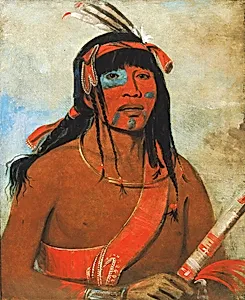
O-tá-wah, The Ottaway, a Warrior
1835
Medium
Painting
Classification
Painting
Department
Smithsonian Collection
Museum
Smithsonian American Art Museum
Credit
Smithsonian American Art Museum, Gift of Mrs. Joseph Harrison, Jr.
Accession Number
1985.66.188
Rights
Public Domain
Tags
About this artwork
George Catlin described this painting as a “portrait of a warrior . . . with his pipe in his hand . . . Smoking is a luxury so highly valued by the Indians, they have bestowed much pains, and not a little ingenuity, to the construction of their pipes. Of these I have procured a collection of several hundreds, and have given facsimile outlines of a number of the most curious. The bowls of these are generally made of the red steatite, or ‘pipe-stone’ (as it is more familiarly called in this countr...
Art Historical Context
George Catlin's *O-tá-wah, The Ottaway, a* (1835) offers a vivid portrait of an Ojib man, pipe in hand, embodying the dignity and daily rituals of Native American life. Painted during Catlin's ambitious expeditions across the American West in the 1830s, this work is part of his monumental effort to document over 600 portraits before Euro-American expansion altered their worlds forever. As a pioneering artist and ethnographer, Catlin captured his subjects with unflinching realism, blending portraiture with cultural observation in oil on canvas. The pipe, central to the composition, highlights a cherished Indigenous luxury. Catlin noted how Native peoples invested ingenuity in crafting these tools from red steatite, or "pipestone," often carving bowls with intricate alto-relievo figures of humans and animals. He amassed hundreds of examples, preserving their artistry amid rapid cultural shifts. This Smithsonian American Art Museum treasure, gifted by Mrs. Joseph Harrison, Jr., underscores pipestone's sacred role in Ojibwa ceremonies and trade, mined from Minnesota quarries revered across tribes. Through *O-tá-wah*, visitors glimpse not just a warrior's gaze, but a vanishing era's ingenuity and spirit—Catlin's urgent call to honor Native heritage.
About the Artist
George Catlin · 1796–1872
George Catlin (1796–1872), born in Wilkes-Barre, Pennsylvania, to Putnam Catlin and Polly Sutton—who had been captured by Native Americans during the 1778 Battle of Wyoming—initially pursued a legal career. Trained at Litchfield Law School, he was admitted to the bar in 1819 but abandoned law after two years to study art in Philadelphia in 1823. Self-taught as a portraitist, Catlin quickly gained ...