
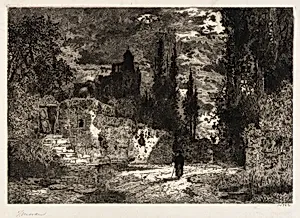
(Old Castle and Trees)
ca. 1880-1890
Medium
Graphic Arts-Print
Classification
Graphic Arts-Print
Department
Smithsonian Collection
Museum
Smithsonian American Art Museum
Credit
Smithsonian American Art Museum, Transfer from the National Museum of American History, Division of Graphic Arts, Smithsonian Institution
Accession Number
1973.122.71
Rights
Public Domain
Tags
Art Historical Context
Thomas Moran's *Old Castle and Trees* (ca. 1880-1890) is a captivating graphic arts print from the Smithsonian American Art Museum's collection. As a leading figure in the Hudson River School, Moran was renowned for his luminous landscapes that celebrated the grandeur of nature. This work, transferred from the National Museum of American History, showcases his skill in printmaking—a medium that democratized art by allowing reproductions to reach wider audiences beyond oil paintings. The composition evokes romanticism through its depiction of ancient castle ruins nestled among towering trees, with a subtle human figure adding scale to the scene. Moran's technique masterfully captures atmospheric depth and textured foliage, blending precise linework with tonal subtlety typical of 19th-century graphic arts. These prints often drew from European inspirations, reflecting a nostalgic fascination with medieval heritage during America's Gilded Age. Housed in the Smithsonian's Graphic Arts division, this piece highlights Moran's versatility, bridging his iconic American wilderness scenes with timeless themes of decay and enduring nature. A perfect gem for visitors pondering humanity's place in the landscape! (198 words)
About the Artist
Thomas Moran · 1837–1926
Thomas Moran (1837–1926) was an American painter and printmaker of the Hudson River School whose dramatic paintings of the American West played a pivotal role in the creation of the national parks. Born in Bolton, Lancashire, England, he emigrated with his family to Philadelphia as a child. He was largely self-taught, though he apprenticed briefly with a wood engraver and studied the work of J.M.W...