
The Bellman
1879
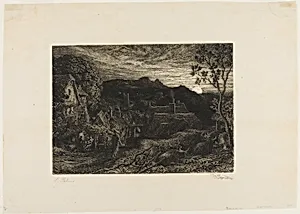
Medium
Etching on paper
Dimensions
Image: 16.7 × 23.5 cm (6 5/8 × 9 5/16 in.); Plate: 19 × 25.2 cm (7 1/2 × 9 15/16 in.); Sheet: 27.2 × 38 cm (10 3/4 × 15 in.)
Classification
etching
Department
Prints and Drawings
Museum
Art Institute of Chicago
Accession Number
28873
Rights
Public Domain
Art Historical Context
Samuel Palmer's *The Bellman* (1879) is a captivating etching on paper, measuring 16.7 × 23.5 cm for the image alone, housed in the Art Institute of Chicago's Prints and Drawings department. Created late in the artist's life, this work exemplifies Palmer's mastery of etching—a printmaking technique where acid bites into a metal plate to create intricate lines and rich tonal depths. Etchings like this allowed Palmer to achieve luminous effects and fine details reminiscent of his earlier pastoral visions, bridging his Romantic roots with Victorian precision. Palmer (1805–1881), a key figure in British Romanticism and the Shoreham Ancients circle influenced by William Blake, shifted in his later years to producing small-scale etchings of rural English life. *The Bellman* likely evokes a moonlit village scene with a town crier, capturing the quiet poetry of everyday traditions amid encroaching modernity. This print reflects 19th-century nostalgia for pre-industrial idylls, a theme central to Palmer's oeuvre. Its artistic significance lies in Palmer's innovative etching style, blending meticulous cross-hatching for texture with ethereal light, making it a gem for print enthusiasts. Visitors will appreciate how this modest sheet (27.2 × 38 cm overall) distills profound atmosphere into intimate scale, inviting contemplation of time's gentle passage.
About the Artist
Samuel Palmer · 1805–1881
Samuel Palmer was born on 27 January 1805 in Newington, London, the son of a bookseller and sometime Baptist minister. He had little formal schooling and almost no conventional artistic training, yet he possessed an instinctive gift for drawing that led him to exhibit Turner-inspired works at the Royal Academy when he was only fourteen years old. In 1824 his mentor, the painter John Linnell, intro...