
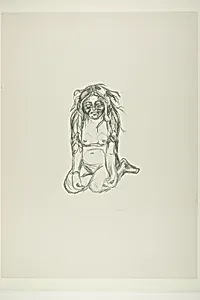
Omega Weeping
1908/09
Medium
Lithograph on paper
Dimensions
Image: 27 × 18.7 cm (10 11/16 × 7 3/8 in.); Sheet: 65.1 × 48.1 cm (25 11/16 × 18 15/16 in.)
Classification
lithograph
Department
Prints and Drawings
Museum
Art Institute of Chicago
Accession Number
93419
Rights
Public Domain
Art Historical Context
Edvard Munch's *Omega Weeping* (1908/09), a poignant lithograph on paper held in the Art Institute of Chicago's Prints and Drawings department, captures the Norwegian artist's signature exploration of existential anguish. Measuring a modest image size of 27 × 18.7 cm on a larger 65.1 × 48.1 cm sheet, this print distills Munch's Expressionist vision into stark black-and-white contrasts, evoking profound emotional depth. Created during Munch's mature period, following his recovery from a nervous breakdown, it reflects themes of sorrow and finality—symbolized by the Greek letter "Omega," denoting an end. As a master printmaker, Munch employed lithography to great effect, drawing directly on the stone with greasy crayon to produce velvety tones and fluid lines that mimic his oil paintings. This technique allowed wide dissemination of his iconic imagery, bridging fine art and popular culture in early 20th-century Europe. *Omega Weeping* echoes motifs from Munch's *Frieze of Life* series, like isolation and melancholy, cementing his role as a pioneer of modern psychological Expressionism. Visitors will appreciate how this intimate work invites reflection on universal human frailty, much like Munch's more famous *The Scream*. Its technical precision and emotional rawness make it a gem for understanding the birth of Expressionism.
About the Artist
Edvard Munch · 1863–1944
Edvard Munch (1863-1944) was a Norwegian painter and printmaker whose intensely psychological works made him a pioneer of Expressionism and one of the most influential artists of the modern era. His 1893 masterpiece 'The Scream' has become an iconic symbol of existential anxiety. Munch's art was profoundly shaped by personal tragedy—his mother died when he was five, his beloved sister Sophie at fo...