
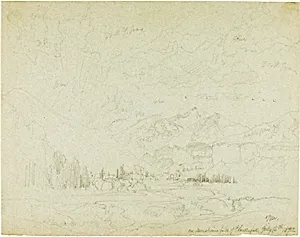
On Sunshine Fork of Clark's Fork
1892
Medium
Drawing
Classification
Drawing
Department
Smithsonian Collection
Museum
Smithsonian American Art Museum
Credit
Smithsonian American Art Museum, Gift of Dr. William Henry Holmes
Accession Number
1930.12.16
Rights
Public Domain
Tags
Art Historical Context
Thomas Moran's *On Sunshine Fork of Clark's Fork* (1892) is a captivating drawing that transports viewers to the majestic mountains of the American West. As a leading figure in the Hudson River School, Moran was renowned for his vivid depictions of untamed landscapes, often sketched during expeditions that celebrated America's natural wonders. This work, housed in the Smithsonian American Art Museum thanks to a gift from Dr. William Henry Holmes, captures a serene summer moment along the Clark Fork River's Sunshine Fork, evoking the crisp air and golden light of high-country serenity. Created as a drawing, the piece highlights Moran's masterful use of pencil or similar media to convey texture and atmosphere—techniques honed from decades of fieldwork. Drawings like this served as vital studies for his grand oil paintings, allowing him to capture fleeting details of rugged peaks, winding rivers, and lush summer foliage with precision and poetic flair. Moran's art played a pivotal role in fostering national pride in the U.S. wilderness during the late 19th century, influencing conservation efforts much like his Yellowstone sketches did. This intimate landscape invites us to pause and appreciate the enduring beauty of America's remote frontiers. (198 words)
About the Artist
Thomas Moran · 1837–1926
Thomas Moran (1837–1926) was an American painter and printmaker of the Hudson River School whose dramatic paintings of the American West played a pivotal role in the creation of the national parks. Born in Bolton, Lancashire, England, he emigrated with his family to Philadelphia as a child. He was largely self-taught, though he apprenticed briefly with a wood engraver and studied the work of J.M.W...