
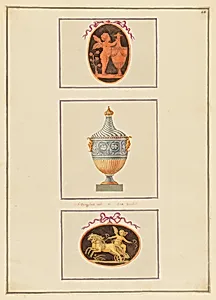
Ornament Design with Urn and Cameos
Medium
Drawing
Classification
Drawing
Department
Smithsonian Collection
Museum
Smithsonian American Art Museum
Credit
Gift of Unknown Donor
Accession Number
1980-32-1456
Rights
Public Domain
About this artwork
Research in Progress
Art Historical Context
**Ornament Design with Urn and Cameos** is a delicate drawing by Michel Angelo Pergolesi, an Italian artist active from around 1760 to 1801. Created in 1776, this work exemplifies the ornamental designs popular in late 18th-century Europe, where artists like Pergolesi crafted intricate patterns inspired by classical antiquity. The title suggests motifs of an urn—symbolizing ancient vessels—and cameos, those carved profile portraits evoking Roman and Greek heritage, blending elegance with historical revival. As a drawing, likely executed in ink or pencil on paper, it served as a blueprint for decorative arts such as textiles, ceramics, or architecture. During the Neoclassical era, such designs fueled a fascination with antiquity, influencing interiors and furnishings across Europe. Pergolesi's Italian roots connect this piece to the rich tradition of ornamental draftsmanship, where precision and symmetry captured the era's refined aesthetic. Now housed in the Smithsonian American Art Museum's Smithsonian Collection—thanks to a gift from an unknown donor—this artwork invites us to appreciate the artistry behind everyday elegance. Though research continues, it stands as a window into 18th-century design ingenuity, reminding visitors how drawings like this shaped the visual culture of their time. (198 words)