
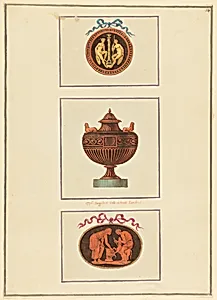
Ornament Design with Urn and Cameos
Classification
Drawing
Department
Smithsonian Collection
Museum
Smithsonian American Art Museum
Credit
Gift of Unknown Donor
Accession Number
1980-32-1464
Rights
Public Domain
About this artwork
Research in Progress
Art Historical Context
**Ornament Design with Ur and Cameos** in 1776 by Italian Michel Angelo Pergolesi active around 1760–1801, this delicate drawing exemplifies the ornamental designs that bridged art and architecture in the late 18th. Pergolesi, known for his intricate patterns, captures classical motifs—an elegant urn flanked by cameos—in a composition likely intended for decorative use in interiors, furniture, or print publications. Housed in the Smithsonian American Art Museum as a gift from an unknown donor, it reflects the era's fascination with antiquity during the Neoclassical revival. The urn, a symbol of ancient funerary art, and cameos, carved profile portraits evoking Roman gems, highlight Pergolesi's skill in adapting Greco-Roman elements for contemporary tastes. These designs influenced British and European decorative arts, blending symmetry and refinement typical of the period. As a drawing from the Smithsonian Collection, it offers a glimpse into the preparatory process of pattern-making, where precision and imagination merged to inspire craftsmen. Though research continues, this work invites us to appreciate how everyday ornamentation carried the weight of history, connecting museum-goers to the elegant world of 1770s design. (198 words)