
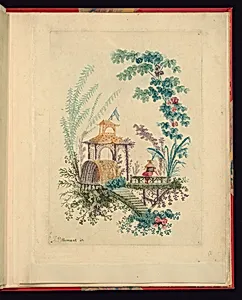
Ornamental Design from "Nouvelle suite de cahiers chinois a l'usage des dessinateurs et des peintres" No.3, Inventes et dessines par Jean Pillement. Graves par Anne Allen.
Classification
ornament
Department
Smithsonian Collection
Museum
Smithsonian American Art Museum
Credit
Purchased for the Museum by the Advisory Council
Accession Number
1921-41-28
Rights
Public Domain
About this artwork
Research in Progress
Art Historical Context
Jean-Baptiste Pillement, a French Rococo artist (1728–1808), created this *Ornamental Design* part of his *Nouvelle suite de cah chinois à l'usage des dessinate et des peintres*New Suite of Chinese Notebooks for Designers and Pain), No. 3. Dated after 1775 and engraved by Anne Allen, exemplifies Pillement's mastery of chinoiserie—a fanciful European adaptation of Chinese motifs that captivated 18th-century decorators. These intricate patterns, blending exotic flora, foliage, and whimsical figures, were designed as practical resources for artists, textile makers, and furniture designers seeking to infuse elegance into everyday objects. Pillement's style, characterized by delicate lines, asymmetry, and playful naturalism, reflects the late Rococo era's love for ornamentation amid shifting tastes toward Neoclassicism. His pattern books were widely influential, disseminating chinoiserie across Europe and beyond, from Versailles wallpapers to English silks. This piece, now in the Smithsonian American Art Museum's collection (purchased by the Advisory Council), highlights the global exchange of ideas in the Enlightenment, where Eastern aesthetics sparked Western creativity. Though the medium remains under research, its classification as an ornament underscores its role in democratizing high design, inviting visitors to imagine it adorning a grand salon or delicate porcelain. A charming window into 18th-century artistic inspiration!