
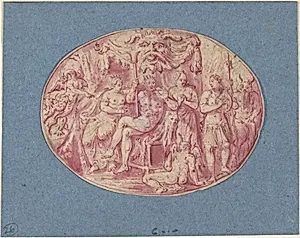
Ornamental design with Orpheus and Eurydice
Medium
Pen and red ink, brush and red wash, oval
Dimensions
sheet: 2 1/2 x 3 5/16 in. (6.3 x 8.4 cm)
Classification
Drawings
Department
Drawings and Prints
Museum
Metropolitan Museum of Art, New York, NY
Credit
The Elisha Whittelsey Collection, The Elisha Whittelsey Fund, 1960
Accession Number
60.620.214
Rights
Public Domain
Tags
Art Historical Context
This delicate oval drawing from the 17th century captures the timeless myth of Orpheus and Eurice in an ornamental format. Created with pen and red ink accented by brush and red wash, the small sheet—measuring just over three inches wide—likely served as a design for decorative objects such as medallions, jewelry, or engraved prints. The composition features the legendary musician Orpheus alongside his beloved Eurydice, rendered as graceful nudes that emphasize both the emotional intensity of their story and the era’s appreciation for classical ideals of beauty. Produced by an anonymous Flemish or Dutch artist during the Baroque period, the work reflects the widespread fascination with ancient Greek and Roman tales across Northern Europe. Mythological subjects like this one frequently adorned luxury items and interiors, blending storytelling with elegant design. The use of red ink and wash creates a warm, sculptural effect, highlighting the figures’ forms while maintaining the piece’s function as a preparatory or ornamental study. Today housed in the Metropolitan Museum of Art’s collection of drawings and prints, this intimate work offers a glimpse into the artistic workshops of the 17th century, where anonymous talents contributed to the rich visual culture of the time.
About the Artist
Anonymous, Flemish, 17th century|Anonymous, Dutch, 17th century · 1600–1700
**Anonymous, Flemish, 17th century** represents one of the many unidentified painters active in the Southern Netherlands during the Baroque era. Early life details for this artist remain unknown, as is typical for figures whose names have not survived in historical records. No specific teachers or mentors are documented, though the body of work reflects the vibrant artistic environment of Antwerp ...