
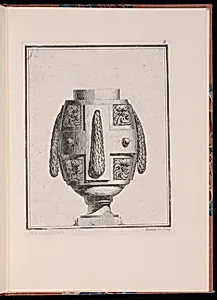
Ornamental Vase Design
Classification
Department
Smithsonian Collection
Museum
Smithsonian American Art Museum
Credit
Purchased for the Museum by the Advisory Council
Accession Number
1921-6-502-15
Rights
Public Domain
About this artwork
Research in Progress
Art Historical Context
**Ornamental Vase** by Jacques-Philippe de Beau (French, 1739–1781), created between 1760 and 1764, exemplifies the elegant ornamental prints that bridged fine art and decorative crafts in mid-18th-century France. a skilled engraver, Beauvais captured intricate vase motifs during the lavish Louis XV era, when opulent designs adorned porcelain, silver, and furniture from renowned manufactories like Sèvres This print likely served as a pattern for artisans, showcasing the period's fondness for flowing curves, floral motifs, and shell-like forms characteristic of the Rococo style. Though the exact medium remains under study—classified simply as a print—this work highlights the pivotal role of such designs in disseminating high-style aesthetics to workshops across Europe. Prints like this democratized luxury, allowing makers to replicate sophisticated patterns with precision. Acquired for the Smithsonian American Art Museum through the Advisory Council's purchase, it reflects the institution's commitment to preserving European influences on American decorative arts. Visitors will appreciate how Beauvais's delicate lines evoke the refinement of pre-Revolutionary France, offering a window into an age of gilded splendor. Ongoing research promises deeper insights into its techniques and provenance. (198 words)