
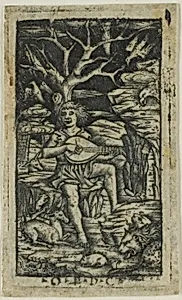
Orpheus Charming the Animals
1490/1510
Medium
Engraving in black, from a niello plate, on ivory laid paper
Dimensions
Plate: 5.3 × 3.1 cm (2 1/8 × 1 1/4 in.); Sheet: 5.5 × 3.4 cm (2 3/16 × 1 3/8 in.)
Classification
engraving
Department
Prints and Drawings
Museum
Art Institute of Chicago
Accession Number
4352
Rights
Public Domain
About this artwork
As early as the sixth century, Italian silversmiths used an enamel-like, black compound called niello to fill incisions in metal and make their ornamentation visible. Dark backgrounds and pronounced contours are common characteristics of niello plate designs. As paper became more readily available in the 15th century, silversmiths made impressions from the niello plates on sheets to check their progress or record their designs. Growing interest in these small pictures soon led artists to engrave...
Art Historical Context
Behold the enchanting *Orpheus Charming the* by Peregrino da Casena, a masterful engraving from around 1490–1510, now housed in the Art Institute Chicago's Prints and Drawings. This tiny gem, measuring just over 2 inches tall, captures the ancient Greek myth of Orpheus, the legendary lyre player whose music tamed wild beasts, birds, and even trees. Surrounded by attentive creatures—lions, deer, and fowl—Orpheus embodies the Renaissance fascination with classical antiquity, harmony between man and nature, and the transformative power of art. Crafted as a black-line engraving from a niello plate on delicate ivory laid paper, this work showcases a rare early printmaking technique. Niello, traditionally used to decorate silver with inlaid black alloy for a gleaming contrast, allowed Peregrino—a Modenese goldsmith and engraver—to produce richly detailed impressions. Active in northern Italy during the late 15th century, he bridged medieval craftsmanship with the emerging Renaissance emphasis on precision and narrative depth. These intimate prints were prized by collectors as affordable alternatives to paintings, spreading humanist ideals through portable art. Its diminutive scale invites close contemplation, revealing Peregrino's fine control over line and texture—fur rippling on animals, strings vibrating on the lyre. A testament to the era's technical innovation, this piece highlights how printmaking democratized beauty, charming viewers across centuries just as Orpheus did the wild.