
Orpheus
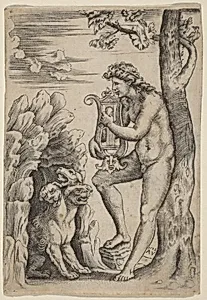
Medium
engraving on laid paper
Dimensions
sheet (trimmed to platemark): 7.9 × 6.2 cm (3 1/8 × 2 7/16 in.)
Classification
Department
CG-E
Museum
National Gallery of Art, Washington, D.C.
Credit
Rosenwald Collection
Accession Number
1954.12.37
Rights
Public Domain
Art Historical Context
Step into the Renaissance world of intricate printmaking with *Orpheus*, a delicate engraving created by Agostino dei Mus in 1528. This Italian artist, also known as Agostino Venez, was a master engr whose works bridged the High Renaissance and emerging Mannerist styles. Measuring just 7.9 × 6.2 cm—trimmed precisely to the platemark print on laid paper captures the mythological musician Orpheus, evoking themes of harmony, loss, and the power of art from classical antiquity. Engraving, Musi's chosen medium, involved meticulously incising fine lines into a copper plate, inking it, and pressing it onto paper to produce richly detailed, reproducible images. This technique revolutionized art dissemination in the 16th century, allowing collectors across Europe to own affordable masterpieces. Housed in the National Gallery of Art's esteemed Rosenwald Collection (Department CG-E), *Orpheus* exemplifies the era's fascination with Greco-Roman myths, blending technical precision with poetic storytelling. Imagine holding this tiny treasure: its small scale made it a coveted cabinet piece for Renaissance connoisseurs, whispering tales of Orpheus's lyre charming beasts and shades. A testament to printmaking's golden age, it invites us to marvel at how one artist's burin could immortalize eternal legends.