
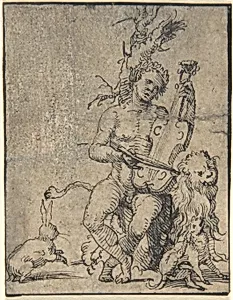
Orpheus Playing to the Animals
Medium
Pen and black ink
Dimensions
3-3/4 x 2-7/8 in. (9.5 x 7.3 cm)
Classification
Drawings
Department
Drawings and Prints
Museum
Metropolitan Museum of Art, New York, NY
Credit
The Elisha Whittelsey Collection, The Elisha Whittelsey Fund, 1998
Accession Number
1998.263
Rights
Public Domain
Tags
Art Historical Context
In the tranquil scene of *Orpheus Playing to the*, created around 1520, we encounter a delicate pen and black ink drawing attributed to Peter Vischer the or an anonymous German artist of the 16th. Measuring just 3-3/4 x 2-7/8 inches, this work from the Metropolitan Museum of Art's Drawings and Prints captures the mythical musician Orpheus enchanting a gathering of animals with his ly. Tags highlight the presence of musical instruments, men and animals—including rabbits—evoking a harmonious moment where nature bends to the power of music. This drawing emerges from the German Renaissance, a period when Nuremberg workshops like the Vischers' fused Northern Gothic precision with emerging Italian influences. Peter Vischer the Younger, son of the famed bronze sculptor, was known for intricate figural works; this sketch may represent a preparatory study, showcasing the fine lines and economical strokes typical of pen-and-ink techniques. Such small-scale drawings were prized for their portability and detail, allowing artists to explore compositions before committing to larger sculptures or panels. The Orpheus theme, rooted in classical antiquity, held cultural resonance in Renaissance Europe as a symbol of art's civilizing force and the soul's transcendence. Here, the animals' rapt attention underscores music's universal appeal, inviting viewers to ponder humanity's bond with the natural world in this gem from The Elisha Whittelsey Collection.