
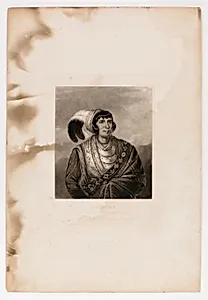
Osceola
Medium
Graphic Arts-Print
Classification
Graphic Arts-Print
Department
Smithsonian Collection
Museum
Smithsonian American Art Museum
Credit
Smithsonian American Art Museum, Transfer from the National Museum of Natural History, Department of Ethnology, Smithsonian Institution
Accession Number
1985.66.386,591D
Rights
Public Domain
Tags
Art Historical Context
George Catlin's *Osceola* is a compelling graphic arts print from the Smithsonian American Art Museum's collection, capturing a waist-length portrait of the Seminole leader Osceola. Catlin, a pioneering 19th-century American artist, dedicated much of his career to documenting American peoples through vivid portraits, traveling extensively across the United States to record their likenesses before widespread cultural disruption. Though the exact date of this print is, it reflects Catlin's mission to preserve Indigenous identities amid rapid change. As a print medium, *Osceola* exemplifies how Catlin's original oil paintings were reproduced for broader audiences, making his ethnographic art accessible beyond elite collectors. The waist-length format emphasizes Osceola's dignified presence, highlighting facial features, attire, and expression—hallmarks of Catlin's realistic yet romanticized style. Transferred from the National Museum of Natural History's ethnology department, this work bridges art and anthropology. This piece holds cultural significance as a visual record of Osceola, a key figure in Seminole resistance during the 1830s Indian Wars. For visitors, it offers a window into Catlin's urgent artistic legacy, celebrating Native American resilience through enduring printed imagery.
About the Artist
George Catlin · 1796–1872
George Catlin (1796–1872), born in Wilkes-Barre, Pennsylvania, to Putnam Catlin and Polly Sutton—who had been captured by Native Americans during the 1778 Battle of Wyoming—initially pursued a legal career. Trained at Litchfield Law School, he was admitted to the bar in 1819 but abandoned law after two years to study art in Philadelphia in 1823. Self-taught as a portraitist, Catlin quickly gained ...