
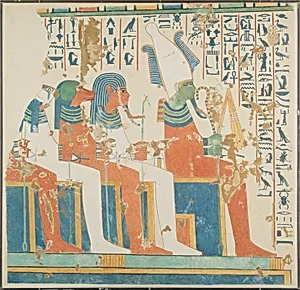
Osiris and the Four Sons of Horus
A.D. 1915; original ca. 1400–1352 B.C.
Medium
Tempera on paper
Dimensions
Facsimile: H. 78.5 × W. 81 cm (30 7/8 × 31 7/8 in.); Framed: H. 80 × W. 82.6 cm (31 1/2 × 32 1/2 in.); Scale. 1:1
Classification
Facsimile, Nebamun (TT 181), Ipuky, Osiris, Fours Sons of Horus
Period
Twentieth Century; original New Kingdom
Department
Egyptian Art
Museum
Metropolitan Museum of Art, New York, NY
Credit
Rogers Fund, 1930
Accession Number
30.4.157
Rights
Public Domain
Tags
About this artwork
This artwork titled "Osiris and the Four Sons of Horus" by Nina de Garis Davies|Hugh R. Hopgood dates to A.D. 1915; original ca. 1400–1352 B.C.. Executed in tempera on paper, this work represents Twentieth Century; original New Kingdom, Dynasty 18, Upper Egypt, Thebes artistic traditions. The piece demonstrates the technical skill and artistic vision characteristic of its period. The work's presence in a major museum collection attests to its significance in the broader narrative of art history....
Art Historical Context
Step into the mystical world of ancient Egypt with *Osiris and the Four of Horus*, a 1:1 scale of a wall painting from Thebes, Upper Egypt, to the New Kingdom's Dynasty 18 (ca. 1400–1352 B.C.). Created in 1915 by skilled copyists Nina de Garis and Hugh R. Hopgood, thisa-on-paper reproduction captures original's vibrant hues and intricate details, now housed in the Metropolitan Museum Art's Egyptian Art collection. At its heart, the scene honors Osiris, the revered god of the afterlife, resurrected by his wife Isis, flanked by his four sons—Imsety, Hapi, Duamutef, and Qebehsenuef. These deities safeguarded the deceased's organs in canopic jars during mummification, embodying protection and renewal central to Egyptian funerary beliefs. Rendered in the iconic "walk-like-an-Egyptian" style, with striding figures in profile, hieroglyphs, and symbolic motifs, it reflects the era's mastery of flat, symbolic composition to convey eternal truths. This facsimile preserves fading tomb artistry for modern eyes, showcasing early 20th-century techniques that blend scientific precision with artistic reverence. Acquired through the Rogers Fund in 1930, it bridges antiquity and today, inviting us to ponder the ancient Egyptians' profound views on death and divinity.
About the Artist
Nina de Garis Davies|Hugh R. Hopgood · 1881–1965
Nina de Garis Davies, born Anna Macpherson Cummings on January 6, 1881, in Salonika, Greece, to English-Scottish parents Cecil J. Cummings and Sarah Macintosh Tannoch, showed early artistic talent as the eldest of three daughters. After her father's death in 1894, the family relocated to Scotland and then London, where she trained at the Slade School of Art. In 1906, at age 25, a holiday trip to E...