
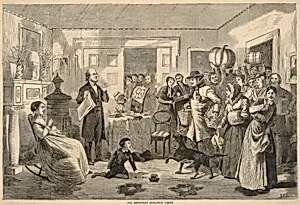
Our Minister's Donation Party, from Harper's Bazar, December 19, 1868
1868
Medium
Graphic Arts-Print
Classification
Graphic Arts-Print
Department
Smithsonian Collection
Museum
Smithsonian American Art Museum
Credit
Smithsonian American Art Museum, The Ray Austrian Collection, gift of Beatrice L. Austrian, Caryl A. Austrian and James A. Austrian
Accession Number
1996.63.161
Rights
Public Domain
Tags
Art Historical Context
Step into the lively chaos of 19th-century American domestic life with Winslow Homer's *Our Minister's Party*, a wood engraving published in *Harper's Bazar* on December , 1868. This print captures a boisterous "donation party"—a cherished community tradition where parishioners gathered at their minister's home, arms laden with food, goods, and cheer to supplement the clergy's modest salary. Homer masterfully depicts a crowded parlor filled with figures: clergy at the center, families jostling with baskets, and children amid the festive clutter, all rendered in his signature realistic style. As a pioneering American realist, honed his skills through magazine illustrations like this one, transitioning from Civil War scenes to everyday that pulsed with humor and humanity. The graphic arts medium—precise wood engraving—allowed intricate details, from patterned rugs to expressive faces, highlighting social dynamics and the warmth of rural or small-town gatherings post-war. Housed in the Smithsonian American Art Museum's Ray Austrian Collection, this piece reflects cultural rituals that knit communities together, offering a window into Victorian-era generosity and the role of print media in shaping public views of American life. A delightful snapshot of faith, festivity, and fellowship!
About the Artist
Winslow Homer · 1836–1910
Winslow Homer (1836-1910) was one of America's greatest painters and a preeminent figure in 19th-century American art. Largely self-taught, Homer began his career as a commercial illustrator and Civil War correspondent for Harper's Weekly before becoming renowned for his powerful marine subjects and landscape paintings. His mastery of both oil and watercolor, combined with his uncompromising reali...