
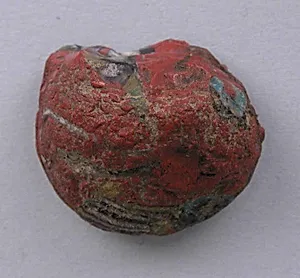
Overfired Millefiori Glass with a Domical Shape, Perhaps a Pawn
Unknown Artist
3rd–12th century
Medium
Millefiori glass
Dimensions
H. 1 1/16 in. (2.7 cm) W. 7/8 in. (2.2 cm) D. 5/8 in. (1.6 cm) Wt. 0.416 oz. (11.795 g)
Classification
Glass
Department
Islamic Art
Museum
Metropolitan Museum of Art, New York, NY
Credit
Gift of Egypt Exploration Fund, 1905
Accession Number
05.4.170
Rights
Public Domain
Art Historical Context
This delicate millefiori glass object, titled *Overfired Millefiori Glass with a Domical Shape, Perhaps a Pawn*, hails from the Islamic world between the 3rd and 12th centuries. Measuring just over 1 inch tall, its petite domical form—resembling a small dome or gaming piece—showcases the ingenuity of ancient glassmakers. Housed in the Metropolitan Museum of Art's Islamic Art Department, it was a gift from the Egypt Exploration Fund in 1905, hinting at its likely origins in Egyptian excavations. Millefiori, meaning "a thousand flowers" in Italian, is a mesmerizing technique where colorful glass rods, each containing intricate patterns, are fused together and sliced thin to reveal floral cross-sections. Here, the glass appears "overfired," meaning it was subjected to excessive heat, causing the patterns to soften, blend, and distort into an abstract, organic beauty. This method, rooted in Roman traditions but perfected in Islamic workshops, was used for beads, amulets, and game pieces, reflecting the era's advanced mastery of glassblowing and mosaic-like designs. Though its exact use remains speculative—perhaps as a chess-like pawn—this tiny treasure illuminates the vibrant glassmaking heritage of medieval Islam. Its survival speaks to the durability and allure of these crafts, inviting us to marvel at the anonymous artisans who turned fire and silica into miniature wonders.