
Oviri
1894
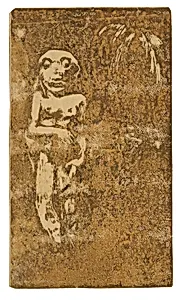
Medium
Wood-block print, printed twice in deep-yellow ocher and brown ink, with touches of black watercolor, on cream wove paper (an imitation Japanese vellum), mounted on mottled blue wove laminate card (recto); wood-block print in black ink over red ink tone block, and brush and solvent-thinned orange wash, on cream wove paper (an imitation Japanese vellum) mounted on mottled blue wove laminate card (verso)
Dimensions
Image: 20.5 × 11.9 cm (8 1/8 × 4 11/16 in.); Sheet: 20.7 × 12.1 cm (8 3/16 × 4 13/16 in.); Secondary support: 23 × 31.6 cm (9 1/16 × 12 1/2 in.)
Classification
woodcut
Department
Prints and Drawings
Museum
Art Institute of Chicago
Accession Number
61354
Rights
Public Domain
Art Historical Context
Paul Gauguin's *Oviri* (1894) is a striking wood-block print that exemplifies the artist's fascination with Polynesian culture and his innovative printmaking techniques. Created shortly after his first voyage to Tahiti (1891–1893), the work draws from Gaug's *Noa Noa*, where "Oviri"—meaning "wild" or "savage" in Tahitian—represents a fierce female spirit. This double-sided piece features a recto printed twice in deep-yellow ocher brown inks with black watercolor accents on imitation Japanese vellum, mounted on mottled blue card; the verso uses black ink over a red tone block with an orange wash. Measuring just 20.5 × 11.9 cm, its intimate scale invites close viewing. Gauguin, a pioneer of Post-Impressionism and Symbolism, turned to woodcuts in the 1890s to explore bold, flattened forms and primal imagery, heavily influenced by Japanese ukiyo-e prints. His rough-hewn carving and layered color printing here mimic wood's texture, evoking a raw, almost sculptural quality. The imitation Japanese paper nods to Japonisme, a craze sweeping European art, while the mottled blue mount adds a decorative frame typical of the era. Housed in the Art Institute of Chicago's Prints and Drawings department, *Oviri* highlights Gauguin's quest for an exotic, spiritual alternative to Western realism. Its experimental techniques bridged painting and printmaking, influencing modern artists like the Fauves and Expressionists, and remains a testament to his rebellious vision.
About the Artist
Paul Gauguin · 1848–1903
Paul Gauguin (1848-1903) was a French Post-Impressionist painter whose bold experiments with color, form, and subject matter made him one of the most influential figures in the transition from 19th-century art to modernism. His rejection of European civilization for the perceived authenticity of 'primitive' cultures established an archetype of artistic exile that continues to resonate. Gauguin's ...