
Oviri
1894
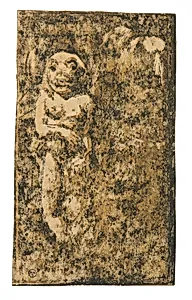
Medium
Wood-block print, printed twice in deep yellow ocher and black ink (recto); wood-block print in black ink over stenciled yellow ink and a red ink tone block (verso); on cream wove paper (an imitation Japanese vellum)
Dimensions
Image/sheet: 20.8 × 12.3 cm (8 1/4 × 4 7/8 in.)
Classification
woodcut
Department
Prints and Drawings
Museum
Art Institute of Chicago
Accession Number
63090
Rights
Public Domain
Art Historical Context
Paul Gauguin's *Oviri* (1894) is a captivating woodcut print from the Art Institute of Chicago's Prints Drawings department, exemplifying the artist's bold experimentation during his Post-Impressionist phase. shortly after his first voyage to Tahiti, this work measures just 20.8 × 12.3 cm, inviting close contemplation of its vivid imagery on cream wove paper mimicking Japanese v—a nod to the ukiyo-e prints profoundly influenced European artists of the era. The print's technical ingenuity shines through its dual-sided execution: the recto employs wood-block printing twice in deep yellow ocher and black ink for rich tonal depth, while the verso layers black ink over stenciled yellow and a red tone block, creating a dynamic interplay of color and texture. Gauguin's innovative approach to woodcuts pushed beyond traditional monochromatic prints, blending flat areas of color with expressive lines to evoke exotic, primal themes central to his oeuvre. As a prime example of late 19th-century printmaking innovation, *Oviri* reflects Gauguin's fascination with non-Western aesthetics and his quest for symbolic intensity, making it a gem for visitors exploring the roots of modern art.
About the Artist
Paul Gauguin · 1848–1903
Paul Gauguin (1848-1903) was a French Post-Impressionist painter whose bold experiments with color, form, and subject matter made him one of the most influential figures in the transition from 19th-century art to modernism. His rejection of European civilization for the perceived authenticity of 'primitive' cultures established an archetype of artistic exile that continues to resonate. Gauguin's ...