
Oxen Yoke
c. 1938
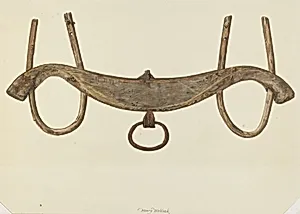
Medium
watercolor, graphite, pen and ink and heightening on paper
Dimensions
overall: 29.7 x 40.8 cm (11 11/16 x 16 1/16 in.)
Classification
Index of American Design
Department
CG-W
Museum
National Gallery of Art, Washington, D.C.
Credit
Index of American Design
Accession Number
1943.8.8079
Rights
Public Domain
Art Historical Context
**Oxen Yoke** by Henry Waldeck, around 1938, is a rendering from the Index of American Design (IAD), a landmark WPA Federal Art Project from the Great Depression era (1935–1942). This initiative employed artists to meticulously document America's folk arts, crafts, and everyday objects, preserving cultural heritage through precise illustrations. Waldeck, one of many talented contributors, captured the humble yet vital oxen yoke—a wooden farming tool essential for plowing fields and hauling loads in early American agriculture. Rendered in watercolor, graphite, pen and ink with heightening on paper (29.7 x 40.8 cm), the work showcases IAD's signature style: hyper-detailed and realistic, blending fine-line drawing for contours, soft graphite shading for depth, vibrant watercolor for wood tones, and white heightening to mimic light on curved surfaces. This multi-medium approach not only highlights the yoke's sturdy craftsmanship but also elevates a utilitarian object into a study of form and function. Housed in the National Gallery of Art's CG-W Department, **Oxen Yoke** symbolizes America's agrarian roots and the ingenuity of its makers. It reminds visitors of the WPA's role in supporting artists while safeguarding vanishing traditions, offering a window into the resilient spirit of rural life.
About the Artist
Henry Waldeck · 1855–present
Henry Waldeck was an American artist active around 1935, best known for his precise watercolor renderings created as part of the Index of American Design, a Federal Art Project under the Works Progress Administration (WPA). This ambitious initiative, spanning 1935 to 1942, commissioned artists across the United States to document everyday objects of American folk art and craftsmanship, preserving ...