
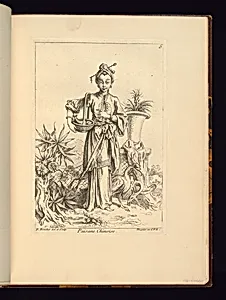
Païsane Chinoise
1738-1745
Classification
Department
Smithsonian Collection
Museum
Smithsonian American Art Museum
Credit
Purchased for the Museum by the Advisory Council
Accession Number
1921-6-246-4
Rights
Public Domain
About this artwork
Research in Progress
Art Historical Context
François Boucher, leading figure of the French Rococo style (1703–1770), *Païsane Chinoise* (Chinese Peasant Woman) between1738 and 1745. As the favored painter of Louis XV, Boucher renowned for his elegant, playful depictions of mythology, pastoral scenes, and exotic themes. This print exemplifies *chinoiserie*, the 18th-century European fascination with imagined Chinese aesthetics, blending delicate Oriental motifs with Boucher's signature lightness, fluid lines, and sensual charm. Printed during the height of Rococo exuberance at Versailles, the work reflects France's cultural obsession with the exotic East, fueled by trade with Asia and porcelain imports. Boucher's interpretations often idealized Chinese life through a Western lens, featuring graceful figures in flowing robes amid lush landscapes. As a print—likely an etching or engraving—it allowed wider dissemination of his opulent designs, influencing decorative arts like wallpaper and furniture. Housed in the Smithsonian American Art Museum's collection, acquired through the Advisory Council, *Païsane Chinoise* offers a window into Enlightenment-era tastes. Though research continues, it highlights Boucher's mastery in translating painting's vibrancy to print, captivating collectors with its whimsical elegance. (198 words)