
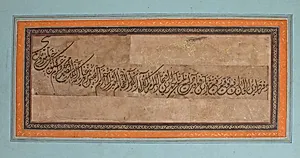
Page of Calligraphy
Unknown Artist
probably 16th–17th century
Medium
Ink on parchment
Dimensions
Overall page: H. 10 1/2 in. (26.6 cm) W. 15 11/16 in. (39.8 cm) Other (Text Block): H. 3 15/16 in. (10 cm) W. 10 5/8 in. (27 cm) Mat: H. 14 1/4 in. (36.2 cm) W. 19 1/4 in. (48.9 cm)
Classification
Codices
Department
Islamic Art
Museum
Metropolitan Museum of Art, New York, NY
Credit
Rogers Fund, 1962
Accession Number
62.152.11
Rights
Public Domain
Tags
Art Historical Context
This exquisite *Page of Calligraphy* the 16th or 17th century exemplifies the pinnacle of Islamic manuscript artistry. Crafted by an unknown master calligrapher using ink on parchment—a durable medium favored for its smooth surface and longevity—this single folium hails from a codex, likely a religious or poetic text. Measuring about 10½ by 15⅞ inches overall, the text block is elegantly centered at roughly 4 by 10½ inches, showcasing the scribe's precision in balancing form and space on the page. In Islamic art, calligraphy was not merely a functional script but a sacred and aesthetic pursuit, often surpassing painting in prestige due to aniconic traditions that discouraged figurative imagery. During the Ottoman, Safavid, or Mughal eras of this period, calligraphers developed flowing styles like naskh or muhaqqaq, employing reed pens to create rhythmic lines that evoke spiritual harmony. Parchment's subtle texture enhanced ink's vibrancy, making such pages ideal for illuminated manuscripts treasured in mosques, libraries, and courts. Acquired through the Rogers Fund in 1962 and housed in The Metropolitan Museum of Art's Department of Islamic Art, this leaf invites visitors to appreciate the anonymous genius behind Islam's most enduring visual language—a testament to cultural devotion and technical virtuosity.