
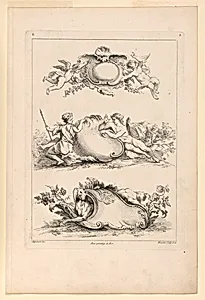
Page Two from "Cinquième Livre Contenant des Cartouches Inventés par G. M. Oppenort Architecte du Roi et Gravé par Huquier"
after 1751
Classification
Department
Smithsonian Collection
Museum
Smithsonian American Art Museum
Credit
Smithsonian American Art Museum
Accession Number
1959-85-26
Rights
Public Domain
About this artwork
Research in Progress
Art Historical Context
This exquisite print, *Page Two from "Cinquième Livre Contenant des Cart Inventés par G.. Oppenord Architecte Roi et Gravé parquier"*, showcases the inventive genius of Gilles-Marie Oppenord1672–1742), a leading French rococo architect and ornamental designer who served as Architect to the King. Published posthumously after 1751 and engraved by the skilled Gabriel Huquier, it forms part of a celebrated series of design books that disseminated Oppenord's elaborate cartouches—scroll-like ornamental frames blending foliage, shells, and fantastical motifs. These pages were essential tools for artisans, architects, and decorators across Europe, capturing the playful asymmetry and exuberant curves of the rococo style that defined early 18th-century French luxury. Oppenord's designs, rooted in his work on Parisian interiors like the Regent's apartments at the Palais Royal, revolutionized decorative arts by emphasizing lightness and movement over baroque heaviness. As a print, this work exemplifies the era's printmaking boom, where copperplate engravings allowed precise replication of intricate patterns for widespread influence—from furniture inlays to book illustrations. Though details of its medium remain under study at the Smithsonian American Art Museum, its survival highlights the enduring appeal of rococo ornament in shaping modern graphic design. Visitors, imagine adorning your own mantelpiece with these whimsical frames—Oppenord's legacy invites us to revel in elegance's joyful excess! (198 words)