
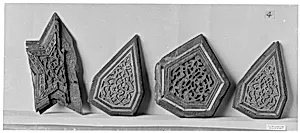
Panel
Unknown Artist
13th–14th century
Medium
Wood; carved, inlaid with ivory
Dimensions
H. 5 3/8 in. (13.7 cm) W. 3 3/8 in. (8.5 cm) D. 11/16 in. (1.8 cm)
Classification
Wood
Department
Islamic Art
Museum
Metropolitan Museum of Art, New York, NY
Credit
Rogers Fund, 1907
Accession Number
07.236.46
Rights
Public Domain
Art Historical Context
This exquisite carved wood panel, dating to the 13th–14th century, hails from the Islamic world and exemplifies the masterful craftsmanship of the era. Measuring just 5 3/8 by 3 3/8 inches, its petite scale suggests it may have adorned a small box, furniture piece, or architectural element, such as a door or mihrab surround. Crafted from wood and inlaid with ivory, the panel showcases a technique where thin ivory pieces were precisely cut and embedded into the wood surface, creating luminous contrasts and intricate patterns typical of Islamic decorative arts. In the medieval Islamic context—likely from regions like Mamluk Egypt or Syria—this inlay method represented the pinnacle of luxury woodworking. Artisans drew on centuries-old traditions, blending geometric precision with organic motifs to evoke spiritual harmony without figurative representation, in line with aniconic principles. The ivory's glow against the wood not only enhanced durability but also symbolized opulence, reserved for elite patrons in palaces, mosques, or scholarly settings. Acquired through the Rogers Fund in 1907 and now in the Metropolitan Museum of Art's Islamic Art Department, this anonymous gem invites us to marvel at the anonymous skill of medieval makers. Its survival speaks to the enduring allure of Islamic art's technical ingenuity and aesthetic refinement.