
Panel
17th century
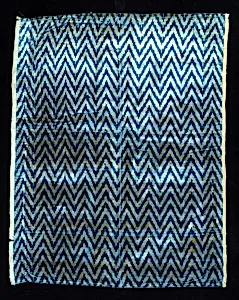
Medium
Silk, warp-float faced 3:1 twill weave with resist dyed supplementary pile warps forming cut solid velvet
Dimensions
66 × 52.8 cm (26 × 20 3/4 in.); Warp repeat: H.: 2.8 cm (1 1/8 in.)
Classification
textile
Department
Textiles
Museum
Art Institute of Chicago
Accession Number
145488
Rights
Public Domain
Art Historical Context
This exquisite 17th-century silk panel showcases the pinnacle of textile artistry from the early modern era, when luxurious fabrics adorned the courts of Europe and beyond. Measuring 66 × 52.8 cm, this fragment exemplifies cut solid velvet, a sumptuous material prized for its plush pile and vibrant sheen. Produced using a sophisticated warp-float faced 3:1 twill weave, it features-dyed supplementary pile warps that create precise patterns repeating every 2.8 cm in height. These techniques demanded masterful skill, as resist dyeing protected areas from color absorption, yielding sharp motifs ideal for opulent garments or furnishings. The panel's construction highlights the technological advancements of 17th-century weaving looms, capable of intricate pile formation where selected warps form the velvet's signature soft loops, then cut for a velvety surface. Velvet was a status symbol, traded along global silk routes from Asia to Europe, symbolizing wealth and refinement. Though the artist remains unknown, such textiles often originated from renowned centers like Italy, Lyon, or the Ottoman Empire, where guilds perfected these methods. Today, at the Art Institute of Chicago's Textiles Department, this panel invites us to appreciate the tactile beauty and labor-intensive craft of historical textiles—reminders of how fabric wove stories of luxury and cultural exchange. (198 words)
About the Artist
Unknown
The artist designated as "Unknown" in our virtual museum's collection exemplifies a poignant chapter in art history: creators whose identities have faded into obscurity despite the enduring power of their work. With only one known artwork attributed to them in our holdings, this figure represents countless anonymous hands that shaped visual culture across centuries. Museums worldwide, including th...