
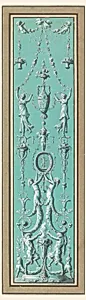
Panel of Arabesques for the Hôtel de Salm, Paris
Medium
ornament
Classification
ornament
Department
Smithsonian Collection
Museum
Smithsonian American Art Museum
Credit
Purchased for the Museum by the Advisory Council
Accession Number
1911-28-219
Rights
Public Domain
About this artwork
Research in Progress
Art Historical Context
This exquisite *Panel of Arabesques the Hôtel de Salm Paris* (1785) was crafted by Jean-Guillaume Moitte, a French sculptor and engraver1746–1810) working in the neoclassical style. Designed as ornamental decoration for the grand Hôtel de Salm—a lavish neoclassical mansion on the Seine, built in the early 1780s for the Count of Salm—it exemplifies the era's fascination with elegant, flowing motifs inspired by antiquity. Arabesques, with their intricate intertwining vines, foliage, and fantastical elements, were a hallmark of French decorative arts, blending rococo playfulness with neoclassical restraint. Moitte's panel captures the opulence of pre-Revolutionary Paris, where such ornaments adorned salons and public spaces to evoke harmony and refinement. As a work in the ornament medium, it highlights the craftsmanship of architectural embellishment, likely intended for stucco relief or paneling. Acquired by the Smithsonian American Art Museum through the Advisory Council, it bridges European elegance with American collections, offering visitors a glimpse into 18th-century luxury amid ongoing research into its precise techniques and installation. Though details are still emerging, this piece invites us to appreciate how decoration shaped elite spaces, reflecting the cultural splendor of Louis XVI's France just before the Revolution.