
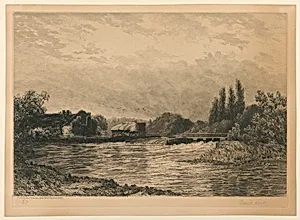
Pangbourne Weir
ca. 1880
Classification
Department
Smithsonian Collection
Museum
Smithsonian American Art Museum
Credit
Bequest of George Campbell Cooper
Accession Number
1896-3-405
Rights
Public Domain
About this artwork
Research in Progress
Art Historical Context
**Pangbourne Weir** by artist David Law (1831–1901), created around 1880, is a captivating print that likely depicts the picturesque weir along the River Thames at Pangbourne, a serene spot in England's Berkshire countryside. As a product of the late Victorian era, this work reflects the era's fascination with the natural of Britain's waterways, a popular subject for artists seeking to capture the interplay of light, water, and foliage. David Law was a skilled practitioner of the etching revival movement in 19th-century Britain, where printmakers elevated the medium to rival painting in expressive detail and tonal subtlety. Though the exact technique here remains under study, Law's prints often showcase meticulous line work that evokes the tranquility and subtle moods of river scenes, inviting viewers to linger on the Thames' timeless charm. Acquired through the bequest of George Campbell Cooper and housed in the Smithsonian American Art Museum's collection, *Pangbourne Weir* bridges British artistic traditions with American collecting tastes. Research continues to uncover more about this piece, but it stands as a window into Victorian leisure and the enduring appeal of landscape prints.