
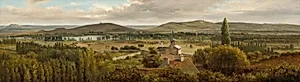
Panoramic Landscape near the River Moselle
c. 1830
Medium
oil on canvas
Dimensions
overall: 22.1 x 75.9 cm (8 11/16 x 29 7/8 in.) framed: 47.6 x 101 x 7 cm (18 3/4 x 39 3/4 x 2 3/4 in.)
Classification
Painting
Department
CF
Museum
National Gallery of Art, Washington, D.C.
Credit
Chester Dale Fund
Accession Number
2003.40.1
Rights
Public Domain
Art Historical Context
Théodore Rousseau’s *Panoramic Landscape near the River Moselle* captures the quiet grandeur of the French countryside in the early nineteenth century. Painted around 1830, when the artist was still in his late teens, the elongated canvas offers a sweeping view that emphasizes the river’s gentle curve and the layered hills beyond. Rousseau, a key figure in the emerging Barbizon school, rejected the dramatic, idealized landscapes of Romanticism in favor of direct observation of nature, often working outdoors to record light, atmosphere, and terrain with greater fidelity. The modest scale and horizontal format of this oil on canvas invite viewers to linger, tracing the subtle shifts in color and texture that convey distance and changing weather. Rousseau’s brushwork balances precise detail in the foreground with softer, atmospheric handling farther away, demonstrating his lifelong commitment to rendering the natural world honestly rather than theatrically. Acquired by the National Gallery of Art through the Chester Dale Fund, the painting stands as an early testament to the artist’s influence on later generations who would likewise celebrate the unassuming beauty of rural France.
About the Artist
Théodore Rousseau · 1812–1867
Théodore Rousseau (1812–1867) was a French landscape painter and the leading figure of the Barbizon School, the group of artists who settled in the village of Barbizon near the Forest of Fontainebleau to paint directly from nature. Born in Paris, he showed precocious talent and studied under the academic painters Charles Rémond and Guillaume Guillon-Lethière, but quickly rejected classical landsca...