
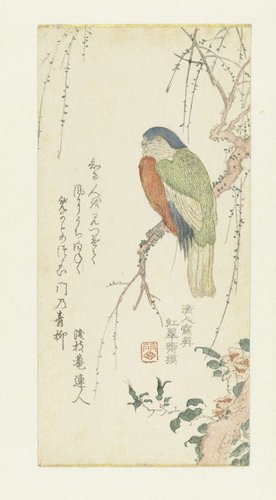
Papegaai in een pruimenboom
ca. 1805 - ca. 1810
Medium
nishikie
Dimensions
203; 176
Rights
Public Domain
About this artwork
verzamelaarsmerk, passe-partout, links onder, gedrukt: JABdH met een haan.
Art Historical Context
Kitao Shigemasa’s “Papegaai in een pruimenboom” (Parrot in a Plum Tree) is a charming example of late Edo-period Japanese woodblock printing. Created around 1805–1810, the small nishikie print measures just 203 by 176 mm yet captures a lively scene of an exotic parrot perched among delicate plum blossoms. Shigemasa, a respected master of the ukiyo-e tradition and founder of the Kitao school, brought a refined sense of observation and color to his bird-and-flower subjects. Nishikie, or “brocade pictures,” represented the pinnacle of Japanese printmaking technology at the time, employing multiple carved blocks to achieve rich, layered hues. Shigemasa’s late-career works often explored such intimate natural motifs, reflecting both the growing interest in imported creatures and the symbolic resonance of plum blossoms—long associated with resilience and the arrival of spring. A small collector’s seal reading “JABdH” with a rooster appears in the lower left margin, reminding viewers that this print has been cherished by generations of enthusiasts. Its modest size and jewel-like palette make it an inviting window into the refined visual culture of early nineteenth-century Japan.
About the Artist
Kitao Shigemasa · 1739–1820
Kitao Shigemasa (1739–1820), born in the bustling Nihonbashi district of Edo (modern Tokyo), emerged as a pivotal figure in ukiyo-e woodblock printing during Japan's Edo period. The eldest son of the bookseller Suharaya Mohei—from a lineage of publishers—Shigemasa, originally named Kitabatake Tarōkichi, was immersed in the world of printing from youth. Largely self-taught, he later studied under t...