
Parabel van Lazarus en de rijke man
Medium
engraving
Dimensions
80; 109
Rights
Public Domain
About this artwork
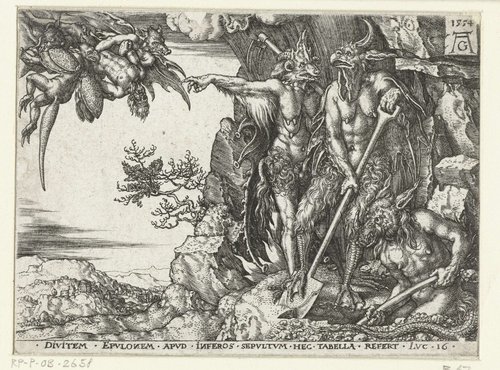
Drie duivels staan bij de ingang van de hel in een rots, drie andere komen aanvliegen met de rijke man. Onder de voorstelling de tekst: Divitem epulonem apud inferos sepultum hec tabella refert Luc 16. Vierde prent uit een serie van vijf.
Art Historical Context
Heinrich Aldegre, a prominent German engraver of the Northern Renaissance and member of the "Little Masters created *Parabel van Lazarus en rijke man* in 1554. This intricate engraving, measuring just 80mm by 109mm, captures a dramatic moment from the Biblical parable in Luke 16 illustrating the fate of the rich man in hell contrasted with the beggar Lazarus in heaven. Aldegrever's reflects the era's intense religious fervor amid the Protestant Reformation, where vivid depictions of divine judgment served as moral warnings to viewers. The scene teems with infernal energy: three devils guard the rocky entrance to hell, while three others swoop in, clutching the tormented rich man. Below the image, Latin text reads, "Divitem epulonem apud inferos sepultum hec tabella refert Luc 16," translating to a reference of the parable's wealthy glutton buried among the damned. As the fourth print in a series of five, it builds narrative tension, showcasing Aldegrever's mastery of engraving—a technique that allowed exceptional detail in miniature formats, enabling widespread dissemination of pious imagery through affordable prints. This small yet powerful work highlights the Northern Renaissance's emphasis on moral storytelling and technical precision, inviting 16th-century audiences to reflect on charity and eternal consequences. Today, it reminds us of art's role in visualizing faith's stark lessons.
About the Artist
Heinrich Aldegrever · 1502–1561
Heinrich Aldegrever, born in 1502 in Paderborn, Westphalia, to parents Herman and Katherine Trippenmeker—a family of clog-makers known by the dialect name Trippenmecker—emerged as a multifaceted artist in the German Renaissance. His early training remains undocumented, though he likely apprenticed in a Soest goldsmith's workshop after relocating there around 1525, where he joined the painters' gui...