
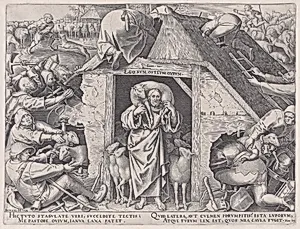
Parable of the Good Shepherd
Medium
Engraving
Dimensions
Plate: 8 3/4 × 11 9/16 in. (22.2 × 29.3 cm)
Classification
Prints
Department
Drawings and Prints
Museum
Metropolitan Museum of Art, New York, NY
Credit
Gift of Julian and Hope Edison, in honor of Nadine Orenstein, 2019
Accession Number
2019.464
Rights
Public Domain
Art Historical Context
Created in 1565, *Parable of the Good Shepherd* is an engraving that reflects the fruitful collaboration between designer Pieter Bruegel the Elder and printmaker Philips Galle. Bruegel, celebrated for his keen observations of human behavior and moral themes, supplied the composition, while Galle translated it into the precise lines of an engraving. This medium, popular in the sixteenth century, enabled images to circulate widely across Europe, extending their reach far beyond the walls of churches or private collections. The subject draws from the well-known biblical parable, inviting viewers to reflect on themes of guidance, care, and spiritual responsibility. Bruegel’s distinctive approach often blended such religious narratives with richly detailed landscapes and everyday figures, encouraging audiences to find contemporary meaning in ancient stories. As a print, the work exemplifies how artists of the Northern Renaissance used reproducible techniques to share complex ideas with diverse viewers. Today housed in the Metropolitan Museum of Art’s Department of Drawings and Prints, this engraving continues to offer insight into the moral and artistic concerns of its time. Its modest size—roughly the dimensions of a small book page—belies the depth of thought it was meant to inspire.
About the Artist
Pieter Bruegel the Elder|Philips Galle · 1525–1569
Pieter Bruegel the Elder, a pioneering Netherlandish painter of the Renaissance, was born around 1525–1530, likely in Breda in the Duchy of Brabant (present-day Netherlands). Little is known of his early family background, but he apprenticed under the Antwerp painter and designer Pieter Coecke van Aelst between approximately 1545 and 1550, mastering tapestry design, architecture, and painting tech...