
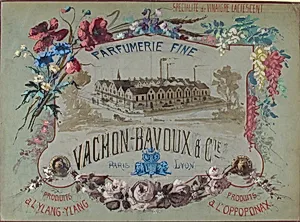
Parfumerie Fine: Vachon-Bachoux et Cie.
19th century
Medium
Graphite, watercolor, and brown wash on blue wove paper
Dimensions
sheet: 11 x 14 15/16 in. (28 x 38 cm)
Classification
Drawings
Department
Drawings and Prints
Museum
Metropolitan Museum of Art, New York, NY
Credit
Gift of Bella C. Landauer, 1925
Accession Number
26.28.154bis
Rights
Public Domain
Tags
Art Historical Context
Step into the elegant world of 19th Parisian commerce with *Parfumerie Fine: Vachon-Bachoux et Cie.*, an anonymous French drawing that captures the allure of a luxury perfume shop. Created on blue wove paper, this delicate work depicts an ornate building facade adorned with blooming flowers, evoking the opulent storefronts that lined the boulevards of France during the Belle Époque era. The title highlights Vachon-Bachoux et Cie., a fine perfumery firm, reflecting the booming trade in fragrances that symbolized sophistication and indulgence for the growing middle class. Rendered in graphite, watercolor, and brown wash, the piece showcases 19th-century drafting techniques favored for commercial illustrations and shop signs. Graphite provides precise lines for architectural details, while translucent watercolor and earthy brown wash add depth and subtle color on the tinted blue paper—a clever method to mimic stone or sky tones efficiently, often used by anonymous artisans in advertising sketches. This charming artifact, gifted to the Metropolitan Museum of Art in 1925 by Bella C. Landauer, offers a glimpse into everyday luxury and the artistry of ephemera. It reminds us how flowers and fine scents intertwined with urban life, blending commerce and beauty in a single, fragrant frame. (198 words)
About the Artist
Anonymous, French, 19th century · 1800–1900
**Anonymous, French, 19th Century (ca. 1800–1900)** The artist cataloged as Anonymous, French, 19th century embodies the enigmatic yet essential contributions of unidentified creators to France's vibrant 19th-century art world. Active roughly between 1800 and 1900, this figure—or potentially collective workshop—produced a diverse array of works amid the nation's transition from Neoclassicism thro...