
Parnassus
c. 1644/1646
Medium
etching
Classification
Department
CG-E
Museum
National Gallery of Art, Washington, D.C.
Credit
Ailsa Mellon Bruce Fund
Accession Number
1972.66.48
Rights
Public Domain
Art Historical Context
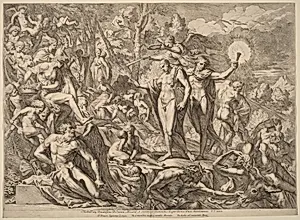
Welcome to the National Gallery of Art, where Pietro Testa's *Parnassus* (c. 1644/1646) invites you into the poetic heights of classical mythology. This exquisite etching, acquired through the Ailsa Mellon Bruce Fund, captures Mount Parnassus—the sacred home of Apollo and nine Muses—in a Baroque vision of inspiration and divine harmony. Testa, a Roman artist active in the mid-17th century, drew from antiquity and the Carracci legacy, blending intricate linework with a sense of elevated grandeur. As a master printmaker, Testa elevated etching beyond mere reproduction, using the medium's precision to weave delicate textures and dynamic compositions. Etching, where acid etches designs into a metal plate, allowed artists like Testa to distribute complex imagery widely, democratizing access to grand themes during the Baroque era's artistic fervor in Italy. Here, the mythical summit symbolizes the Renaissance humanist ideal of artistic patronage and creativity. *Parnassus* reflects Testa's scholarly passion for classical sources, offering visitors a window into 17th-century Rome's intellectual circles. Gaze closely at the fine lines, and you'll feel the Muses' timeless call to imagination. (178 words)
About the Artist
Pietro Testa · 1612–1650
Pietro Testa was born in Lucca in 1612 and, in accordance with the conventions of Italian artistic training, made his way to Rome while still young. There he studied under two of the leading painters of the early seventeenth century: Domenichino, from whom he absorbed a taste for classical restraint and narrative clarity, and Pietro da Cortona, whose more exuberant Baroque manner offered a contras...