
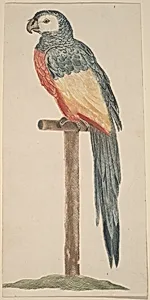
Parrot (Ara)
c. 1685-1697
Medium
color engraving inked à la poupée on laid paper
Dimensions
sheet (cut within platemark): 20.2 x 9.4 cm (7 15/16 x 3 11/16 in.)
Classification
Department
CG-E
Museum
National Gallery of Art, Washington, D.C.
Credit
Gift of A. Thompson Ellwanger III and Gregory E. Mescha in memory of Arthur R. Watson
Accession Number
2000.17.2
Rights
Public Domain
Art Historical Context
Behold the vibrant *Parrot (Ara)*, a exquisite color engraving produced in the workshop of Dutch artist Johann Teyler around 1685–1697. Teyler, a master engraver from Haarlem during the Dutch Golden Age, in meticulously detailed natural history prints, capturing the exotic beauty of birds with scientific precision. This small-scale work (20.2 x 9.4 cm) on laid paper showcases his innovative *inked à la poupée* techniqueusing cotton "dolls" to apply multiple colors directly to the plate before printing, creating a luminous, multi-hued effect in a single impression that rivals hand-colored works. In the late 17th century, Europe’s fascination with the natural world fueled a boom in such illustrations, reflecting expanding global trade and colonial exploration. Parrots like the scarlet Ara macaw symbolized luxury and wonder, often featured in cabinets of curiosities among the elite. Teyler’s print exemplifies this era’s blend of artistry and emerging scientific inquiry, bridging Baroque ornamentation with proto-ornithological accuracy. Today, this gem from the National Gallery of Art’s collection—generously gifted in memory of Arthur R. Watson—invites visitors to marvel at how 300-year-old techniques bring a tropical marvel vividly to life, a testament to printmaking’s enduring power to transport and educate.