
Parure: tiara, necklace, and brooch
mid-19th century
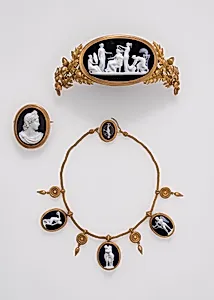
Medium
Onyx and gold, tortoiseshell
Dimensions
Diadem, visible cameo: 1 13/16 x 3 1/16 in. (4.7 x 7.8 cm); 46.8 x 78 mm; Diadem, overall with setting: 2 1/4 x 5 5/8 in.; Brooch, visible cameo: 1 11/16 x 1 5/16 in. (4.3 x 3.3 cm); 42.6 x 33.4 mm; Brooch, overall with setting: 2 1/16 x 1 11/16 in.; Necklace, overall length: 17 1/2 in. (43.8 cm) Necklace, visible cameo at clasp: 20.2 x 14.6 mm; visible cameo at PL: 26.7 x 20.9 mm; visible cameo at center: 29 x 23.1 mm; visible cameo at PR: 27.2 x 20.7 mm
Classification
Lapidary Work-Gems
Culture
Italian, Rome
Department
European Sculpture and Decorative Arts
Museum
Metropolitan Museum of Art, New York, NY
Credit
The Milton Weil Collection, 1940
Accession Number
40.20.55a–c
Rights
Public Domain
Tags
Art Historical Context
This exquisite parure—a matched set of tiara (diadem), necklace, brooch—was crafted in mid-19th-century Rome by the British neoclassical sculptor John Gibson and the Roman goldsmith Luigi Saulini.ed from onyx cameos set in gold and tortoiseshell, it exemplifies the era's revival of ancient Roman lapidary arts. The precisely carved onyx gems, with their striking black-and-white contrast, depict mythological figures like Cupid, Apollo, Psyche, drawing from classical tales of love and divine beauty. Cameo carving, a technique honed since antiquity, reached new heights in 19th-century Italy, where artists like Gibson transformed hardstone into intricate relief portraits. Gibson's sculptural expertise shines in the detailed figures, while Saulini's ornate gold and tortoiseshell mounts add elegance and wearability. Worn by elite women during the Grand Tour era, such jewelry bridged antiquity and modernity, serving as both fashion statement and cultural trophy. Housed in The Metropolitan Museum of Art's Milton Weil Collection, this parure highlights Rome's role as a hub for neoclassical decorative arts, blending technical virtuosity with timeless mythology to captivate admirers of Victorian-era finery.
About the Artist
John Gibson|Luigi Saulini · 1790–1866
Outstanding Neoclassical sculptor who experimented with the ancient practice of coloring statues, e.g. his 'Tinted Venus' (1851). Flaxman encourgaged him to go to Rome, where he spent most of his life. He left his fortune to the National Gallery, London. British sculptor, active Rome. Comment on works: sculptor