
Paul Cezanne
1902
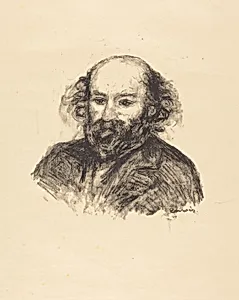
Medium
lithograph
Classification
Department
CG-E
Museum
National Gallery of Art, Washington, D.C.
Credit
Gift of Mr. and Mrs. Burton Tremaine
Accession Number
1971.86.34
Rights
Public Domain
Art Historical Context
This lithograph, created by Auguste Renoir in 1902, offers a compelling portrait of fellow artist Paul Cézanne. As a leading figure of Impressionism, Renoir brings his characteristic warmth and fluid line to the medium, capturing Cézanne at a time when both painters were reflecting on their shared artistic journeys. The work highlights the deep respect between these two masters, who had known each other since the 1860s and often exchanged ideas about color, form, and the evolving direction of modern art. Printed as a lithograph, the piece demonstrates the importance of this reproductive technique in the late 19th and early 20th centuries. Lithography allowed artists to reach broader audiences beyond the elite circles of collectors, making original works more accessible while preserving the spontaneity of drawing. Renoir’s choice of medium here underscores his interest in bridging fine art traditions with wider cultural appreciation. Now part of the National Gallery of Art’s collection through the generous gift of Mr. and Mrs. Burton Tremaine, this print serves as a quiet testament to the bonds within the Impressionist circle and the enduring influence of Cézanne on his contemporaries.
About the Artist
Auguste Renoir · 1841–1919
Pierre-Auguste Renoir (1841-1919) was a founding figure of Impressionism whose luminous depictions of Parisian leisure, sensuous female forms, and sun-dappled landscapes made him one of the most beloved painters in Western art history. Born in Limoges to a working-class family, Renoir began as a porcelain painter before pursuing fine arts, and this early craft experience gave him facility with the...