
Portrait of Cezanne
c. 1902
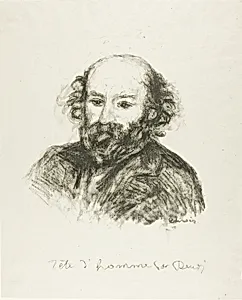
Medium
Lithograph on grayish ivory wove paper
Dimensions
Image: 23 × 23.5 cm (9 1/16 × 9 5/16 in.); Sheet: 39 × 31.6 cm (15 3/8 × 12 1/2 in.)
Classification
lithograph
Department
Prints and Drawings
Museum
Art Institute of Chicago
Accession Number
83668
Rights
Public Domain
Art Historical Context
Step into the intimate world of Pierre-Augusteoir's *Portrait of Cézanne* (c. 1902), a lithograph that captures the essence of one artistic giant by another. Renoir, a leading Impressionist known for his luminous depictions of light and everyday life, here turns his gaze to Paul Cézanne, the Post-Impressionist whose innovative approach to form and color profoundly influenced modern art. Created late in Renoir's career, this work reflects their deep friendship and mutual respect within Paris's vibrant art scene at the turn of the century. Rendered in lithography—a printmaking technique where the artist draws with greasy crayon on a flat stone, allowing ink to adhere only to those marks—this portrait exemplifies Renoir's mastery of subtle tonal gradations. Printed on grayish ivory wove paper, the image measures a modest 23 × 23.5 cm, inviting close contemplation of its delicate lines and soft modeling. Lithography's reproducibility made such portraits more accessible, bridging fine art with a broader audience. Housed in the Art Institute of Chicago's Prints and Drawings Department, this piece highlights the technical innovation of the medium while celebrating the camaraderie of Impressionism's inner circle. A testament to artistic legacy, it reminds us how personal bonds shaped the evolution of 20th-century art.
About the Artist
Pierre-Auguste Renoir · 1841–1919
Pierre-Auguste Renoir (1841-1919) was a founding figure of Impressionism whose luminous depictions of Parisian leisure, sensuous female forms, and sun-dappled landscapes made him one of the most beloved painters in Western art history. Born in Limoges to a working-class family, Renoir began as a porcelain painter before pursuing fine arts, and this early craft experience gave him facility with the...