
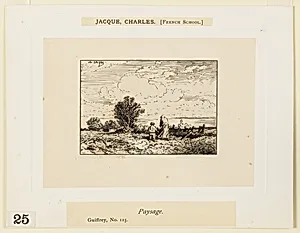
Paysage
Classification
Department
Smithsonian Collection
Museum
Smithsonian American Art Museum
Credit
Gift of Samuel P. Avery
Accession Number
1898-6-49
Rights
Public Domain
About this artwork
Research in Progress
Art Historical Context
**Paysage (Landscape)**, created by French artist Charles Émile Jacque in 6, captures the essence of rural France during a pivotal era in art history. Jacque (1813–1894), a key figure in the Barbizon School, was renowned for his depictions of pastoral scenes, peasants, and barnyard animals, blending Realism with a romantic appreciation for nature. This print, housed in the Smithsonian American Art's Smithsonian Collection as a gift from Samuel P Avery, reflects the mid-19th-century toward en plein air observation, influenced by Jacque's time in Barbizon village alongside artists like Millet and Rousseau. As a print from an unknown specific medium—likely etching, given Jacque's mastery of the technique—this work exemplifies the era's democratization of art. Prints allowed intricate details of landscapes, from rolling hills to textured foliage, to be reproduced affordably, bringing fine art to wider audiences beyond oil paintings. Jacque's precise lines and tonal contrasts evoke the tranquility and labor of countryside life, offering a window into pre-industrial France. Though research on this piece is ongoing, *Paysage* invites visitors to ponder the artist's lifelong passion for the everyday sublime, bridging Romanticism and emerging Modernism in European printmaking.