
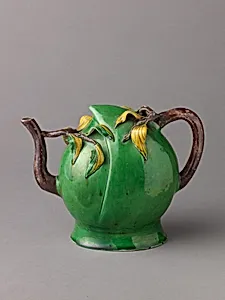
Peach-Shaped Wine Pot or Tea Pot
ca. 1644–83
Medium
Porcelain with relief decoration under polychrome glazes.
Dimensions
Height: 12.7 cm.
Classification
Ceramics-Porcelain
Culture
Chinese
Department
Robert Lehman Collection
Museum
Metropolitan Museum of Art, New York, NY
Credit
Robert Lehman Collection, 1975
Accession Number
1975.1.1719
Rights
Public Domain
Tags
Art Historical Context
This delightful peach-shaped wine pot or teapot, crafted in China around 1644–83 during the early Qing dynasty, exemplifies the period's masterful porcelain artistry. Standing just 12.7 cm tall, its whimsical form mimics a ripe peach, complete with relief-decorated leaves, a playful nod to nature that was popular among imperial and elite collectors. Produced likely at Jingdezhen, the epicenter of Chinese porcelain innovation, it reflects the transition from Ming opulence to Qing refinement, when potters revived and expanded glazing techniques after years of turmoil. The vessel's medium—porcelain with raised relief decoration beneath vibrant polychrome glazes—highlights technical prowess. Artisans molded the peach's plump contours and leafy details in low relief before applying colorful overglazes, fired to achieve a luminous, durable finish. In Chinese culture, the peach symbolizes immortality and longevity, evoking Daoist legends of the gods' fruit of eternal life, making this functional yet fanciful object both practical for serving wine or tea and auspicious for the table. Now housed in the Robert Lehman Collection at The Metropolitan Museum of Art (1975), this piece invites visitors to appreciate how everyday ceramics blended utility, symbolism, and sculptural beauty in 17th-century China.
About the Artist
Chinese
The artist known simply as "Chinese" in museum records represents the vast tradition of anonymous or unattributed masters in Chinese art history, with 99 works preserved in our collection. These pieces exemplify the enduring legacy of guó huà, or traditional Chinese painting, one of the world's oldest continuous artistic practices. Early life is not well documented, as is common for many practitio...