
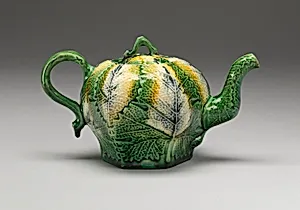
Teapot
1760/75
Medium
Lead-glazed earthenware (creamware)
Dimensions
9.9 × 17.2 × 8.8 cm (3 7/8 × 6 3/4 × 3 7/16 in.)
Classification
teapot
Department
Applied Arts of Europe
Museum
Art Institute of Chicago
Accession Number
72618
Rights
Public Domain
Art Historical Context
This elegant teapot, crafted around 1760–1775, exemplifies creamware—a refined lead-glazed earthenware that revolutionized European ceramics during the 18th century. Produced in England, creamware offered a creamy, translucent glaze over a durable earthenware body, mimicking the luxury of Chinese porcelain at a fraction of the cost. Its dimensions (9.9 17.2 × 8.8 cm) made it ideal for domestic use, blending functionality with subtle sophistication in the Applied Arts of Europe. The period marked the height of tea culture in Britain and its colonies, where teapots like this became symbols of refined hospitality. Lead glazing provided a smooth, glossy finish that enhanced both aesthetics and practicality, resisting stains from daily tea rituals. Though the artist remains unknown, such pieces were often made in factories like those of Josiah Wedgwood, who popularized creamware for middle-class households. Housed in the Art Institute of Chicago, this teapot highlights how everyday objects embodied artistic innovation and cultural shifts, democratizing elegance in the Age of Enlightenment. Visitors can appreciate its tactile charm up close, a testament to 18th-century ingenuity.
About the Artist
Unknown
The artist designated as "Unknown" in our virtual museum's collection exemplifies a poignant chapter in art history: creators whose identities have faded into obscurity despite the enduring power of their work. With only one known artwork attributed to them in our holdings, this figure represents countless anonymous hands that shaped visual culture across centuries. Museums worldwide, including th...