
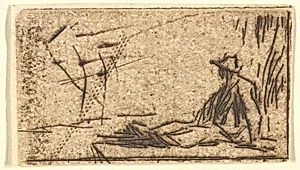
Peasant Seated on the Ground
1830–75
Medium
Etching on laid paper
Dimensions
sheet: 15/16 x 1 5/8 in. (2.4 x 4.1 cm)
Classification
Prints
Department
Drawings and Prints
Museum
Metropolitan Museum of Art, New York, NY
Credit
The Elisha Whittelsey Collection. The Elisha Whittelsey Fund, 1963
Accession Number
63.621.12
Rights
Public Domain
Tags
Art Historical Context
Jean-François Millet’s “Peasant Seated on the Ground” offers a quiet glimpse into rural life through the figure of a lone man resting on the earth. Created sometime between 1830 and 1875, the etching reflects Millet’s lifelong attention to the humble gestures and dignity of agricultural workers, subjects that resonated deeply with nineteenth-century audiences seeking honest portrayals of everyday existence. The choice of etching on laid paper is well suited to this intimate scene. The technique’s fine, incised lines allow subtle modeling of the figure within a remarkably small sheet measuring just under one by two inches. Such modest dimensions encourage viewers to draw near, turning the print into a personal encounter rather than a grand statement. Now part of the Metropolitan Museum’s Drawings and Prints collection, the work exemplifies how prints helped spread Millet’s vision of peasant life beyond the walls of elite salons, making images of rural labor accessible to a wider public.
About the Artist
Jean-François Millet · 1814–1875
Jean-François Millet (1814-1875) was a French painter and one of the founders of the Barbizon school, whose dignified depictions of peasant laborers transformed how art could represent rural life. His monumental images of sowers, gleaners, and field workers elevated common people to subjects previously reserved for mythological or historical figures, making him a pivotal figure in the development ...