
Playing Card
c. 1470
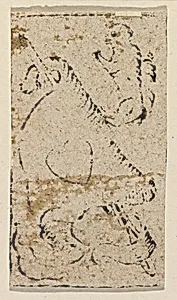
Medium
woodcut
Classification
Department
CG-E
Museum
National Gallery of Art, Washington, D.C.
Credit
Rosenwald Collection
Accession Number
1943.3.710
Rights
Public Domain
Art Historical Context
Step into the vibrant world of15th-century Germany with this humble yet remarkable *Playing Card*, created around 1470. Produced during the dawn of the printing revolution—sparked by Johannes Gutenberg's movable type just two decades earlier—this woodcut exemplifies the era's innovative spirit. Anonymous German artisans crafted such cards as affordable entertainment for all social classes, reflecting the growing middle class's appetite for leisure amid the late Gothic and early Renaissance periods. The woodcut technique, one of the earliest forms of printmaking, involved carving an image in reverse onto a wooden block, inking it, and pressing it onto paper. This method allowed for bold, simplified lines and high-contrast designs ideal for playing cards, which needed to be legible from afar during games. Its survival in the National Gallery of Art's Rosenwald Collection highlights its rarity; few such early prints endure, offering a glimpse into the commercialization of graphic arts. Culturally, this card underscores playing cards' rapid spread across Europe from Asian origins, evolving into a social staple by the 1470s. Whether depicting suits like hearts or aces, it captures a playful slice of medieval life, bridging art, technology, and everyday fun.
About the Artist
German 15th Century · 1400–1500
**German 15th Century** The designation "German 15th Century" encompasses a collective of anonymous artists active in the late medieval and early Renaissance periods in Germany, primarily known through their contributions to early printmaking and panel painting. These creators emerged during a transformative era when woodcuts and engravings began democratizing religious imagery, bridging the Goth...