
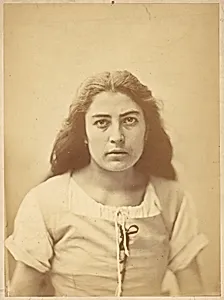
[Peasant Woman]
1870s
Medium
Albumen silver print from glass negative
Classification
Photographs
Department
Photographs
Museum
Metropolitan Museum of Art, New York, NY
Credit
Purchase, Emanuel Gerard Gift, 1982
Accession Number
1982.1096.2
Rights
Public Domain
Tags
Art Historical Context
This poignant *Peasant Woman*, an albumen silver print from a negative dating to the 1870s, captures the quiet dignity of rural life in an era of rapid industrialization. Created by an unknown photographer, the image falls squarely within the portraiture tradition, highlighting the everyday resilience of working-class women. part of the Metropolitan Museum Art's Photographs Department—quired through the Emanuel Gerard in 1982—it 19th-century documentary photography's power to preserve overlooked stories. Albumen prints, the most popular photographic medium from the 1850s to 1890s, used egg whites to bind light-sensitive silver salts to paper, yielding rich tones and fine detail from glass negatives. This technique, often paired with the wet collodion process, demanded skill and immediacy, making each image a technical marvel. The portrait's focus on a peasant woman reflects photography's growing role in social observation, bridging fine art and realism during Europe's agrarian transitions. Though the artist's identity remains elusive, *Peasant Woman* invites us to ponder the lives behind the lens—women whose labor sustained societies yet rarely made headlines. A testament to photography's democratic gaze, it reminds visitors of the medium's enduring ability to humanize history.
About the Artist
Unknown
The artist designated as "Unknown" in our virtual museum's collection exemplifies a poignant chapter in art history: creators whose identities have faded into obscurity despite the enduring power of their work. With only one known artwork attributed to them in our holdings, this figure represents countless anonymous hands that shaped visual culture across centuries. Museums worldwide, including th...