
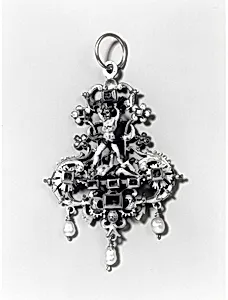
Pendant with Cain and Abel
Unknown Artist
second half 19th century
Medium
Gold enamel, rubies and pearls.
Dimensions
H. 6.5 cm, W. 4.7 cm.
Classification
Jewelry, Precious Metals and Precious Stones
Culture
Austrian (Vienna) or German (Frankfurt-am-Main)
Department
Robert Lehman Collection
Museum
Metropolitan Museum of Art, New York, NY
Credit
Robert Lehman Collection, 1975
Accession Number
1975.1.1512
Rights
Public Domain
Tags
Art Historical Context
This exquisite pendant, created in the second half of the 19th century, brings the biblical story of Cain and Abel to life through masterful jewelry craftsmanship. Likely produced in Vienna or Frankfurt-am-Main, the small gold piece (just 6.5 cm high) uses vibrant enamel to depict the brothers in vivid detail, accented with rubies and pearls for a rich, luminous effect. Such religious subjects were popular in European jewelry of the era, reflecting a blend of devotional meaning and fashionable display. The combination of gold enamel with precious stones highlights advanced 19th-century techniques that allowed jewelers to create miniature narrative scenes on wearable objects. Enamel provided durable color and fine lines, while the gems added symbolic depth—rubies for intensity and pearls for purity—making the pendant both a work of art and a personal treasure. Housed in the Metropolitan Museum of Art’s Robert Lehman Collection since 1975, this Austrian or German piece offers a window into how biblical tales like the story of Cain and Abel were woven into everyday luxury during the period. Its intimate scale encourages close viewing, revealing the quiet drama of one of the Bible’s earliest narratives.