
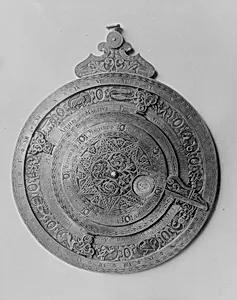
Perpetual calendar with lunar and solar tables
Unknown Artist
19th century
Medium
Steel, silver details
Dimensions
Overall: 10 3/8 × 8 1/2 in. (26.4 × 21.6 cm)
Classification
Horology
Culture
European
Department
European Sculpture and Decorative Arts
Museum
Metropolitan Museum of Art, New York, NY
Credit
Rogers Fund, 1906
Accession Number
06.174
Rights
Public Domain
Tags
Art Historical Context
Step into the intricate world of 19th European horology with this exquisite *Perpetual calendar with lunar and solar tables*, a masterful blend of science and artistry crafted from steel with gleaming silver details. Measuring just 10 3/8 × 8 1/2 inches, this compact device exemplifies the era's fascination with precision timekeeping and celestial mechanics. As a perpetual calendar, it ingeniously tracks dates, lunar phases, and solar cycles indefinitely, without needing annual adjustments—a testament to the mechanical sophistication of European clockmakers during the Industrial Revolution. Classified within the Metropolitan Museum of Art's European Sculpture and Decorative Arts collection, this unknown artist's creation highlights horology's dual role as functional tool and decorative object. The steel body provides durability for its complex gears and dials, while silver accents add a touch of luxury, making it suitable for scholarly gentlemen or affluent collectors. Tags noting animals and calendars suggest symbolic motifs, perhaps zodiac signs or pastoral scenes, evoking the cultural interplay between astronomy, mythology, and daily life in Victorian Europe. Acquired through the Rogers Fund in 1906, this piece invites visitors to marvel at how 19th-century innovators transformed abstract cosmic rhythms into tangible, elegant metalwork—bridging art, science, and the eternal dance of time.