
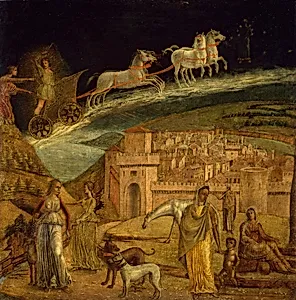
Phaeton Driving the Chariot of Phoebus
1475/1500
Medium
Tempera or distemper on canvas
Dimensions
55.3 × 55.6 cm (21 3/4 × 21 13/16 in.); Framed: 68.3 × 68.9 × 7.7 cm (26 7/8 × 27 1/8 × 3 in.)
Classification
painting
Department
Painting and Sculpture of Europe
Museum
Art Institute of Chicago
Accession Number
102098
Rights
Public Domain
Art Historical Context
This striking circular painting captures a dramatic moment from classical mythology: the ill-fated Phaeton attempting to steer the chariot of Phoebus, the sun god. Created by an unknown Northern Italian artist between 1475 and 1500, the work reflects the Renaissance fascination with ancient stories, particularly those drawn from Ovid’s Metamorphoses. The scene likely served as a decorative panel, perhaps for a palace ceiling or furniture, where such mythological narratives warned against hubris while delighting viewers with celestial spectacle. Painted in tempera or distemper on canvas—a medium that allowed for lighter, more portable works than traditional panel painting—the composition emphasizes movement and tension as the young driver struggles with the fiery horses. Its modest size and round format suggest it was designed to be viewed from below, enhancing the sense of soaring through the heavens. As part of the Art Institute of Chicago’s European painting collection, this piece offers a vivid glimpse into how 15th-century Italian patrons used art to connect with the grandeur and moral lessons of antiquity.