
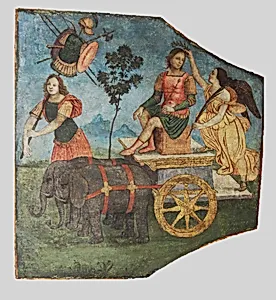
Triumph of Alexander
ca. 1509
Medium
Fresco, transferred to canvas and attached to wood panels
Dimensions
Overall: 30 1/4 × 28 1/2 in. (76.8 × 72.4 cm)
Classification
Paintings-Decorative
Culture
Italian, Umbria
Department
European Sculpture and Decorative Arts
Museum
Metropolitan Museum of Art, New York, NY
Credit
Rogers Fund, 1914
Accession Number
14.114.10
Rights
Public Domain
Tags
Art Historical Context
Created around 1509 by the Umbrian Renaissance master Pinturicchio, *Triumph of Alexander* captures the grandeur of classical antiquity through a vivid procession scene. The fresco, later transferred to canvas and mounted on wood panels, depicts armored figures, elegantly dressed women, and exotic elephants—elements that evoke Alexander the Great’s legendary campaigns in the East. Pinturicchio, celebrated for his luminous colors and narrative clarity in works such as the Borgia Apartments frescoes, brings a sense of pageantry and movement to this intimate-scale composition. As a decorative painting originally intended for an interior setting, the work reflects the Renaissance fascination with ancient heroes as models of power and virtue. Elephants, rarely seen in European art of the period, underscore the exotic reach of Alexander’s empire while showcasing the artist’s skill at rendering unfamiliar forms with imaginative detail. Today in the Metropolitan Museum’s collection, the piece offers visitors a window into how sixteenth-century patrons used classical imagery to express cultural sophistication and worldly ambition.