
Philippe Le Roy
1630/40
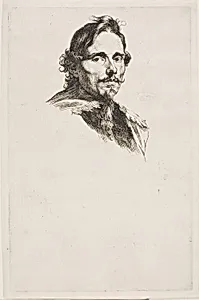
Medium
Etching, with stippling, in black on ivory laid paper
Dimensions
Image/plate: 24.1 × 15.5 cm (9 1/2 × 6 1/8 in.); Sheet: 25.6 × 16.9 cm (10 1/8 × 6 11/16 in.)
Classification
etching
Department
Prints and Drawings
Museum
Art Institute of Chicago
Accession Number
34314
Rights
Public Domain
About this artwork
Anthony van Dyck produced stand-alone portraits of famous men as well as those in his Iconography; all of them went through multiple states of engraving. This, the first state, included only the sitter’s head. Another artist likely added the body and framing elements to the four state. The final state would include text describing the sitter and his coat of arms. Baron Philippe Le Roy was a Flemish diplomat who would help end the Thirty Years’ War in 1648; Van Dyck had already painted his portra...
Art Historical Context
Anthony van Dyck's *Philippe Le Roy* (ca. 1630–40) is a striking portrait etching from the Flemish master's renowned *Iconography* series, collection of over 100 prints depicting Europe's intellectual and noble elite. Created during van Dyck's mature career, when he bridged Antwerp and the English court of Charles I, this work captures the Antwerp publisher and bookseller Philippe Le Roy van Dyck's signature elegance and psychological depth. Le Roy's poised gaze and refined attire reflect the Baroque era's fascination with status and humanism, immortalizing a key figure in the vibrant print culture of 17th-century Europe. The etching, executed with meticulous stippling on ivory laid paper, showcases van Dyck's innovative printmaking technique. Stippling—tiny dots to build subtle tones and textures—lent a painterly softness rare in etchings, bridging his oil portraits' luminosity with the reproductive power of prints. Measuring about 9½ × 6⅛ inches, it exemplifies how van Dyck, primarily a painter, elevated etching to fine art, influencing generations of portraitists. Housed in the Art Institute of Chicago's Prints and Drawings department, this piece highlights the democratizing role of prints: affordable yet exquisite, they spread van Dyck's vision across continents, blending artistry with cultural prestige. A testament to 17th-century collaboration between artist and patron, it invites us to ponder the unsung heroes behind the era's intellectual boom.
About the Artist
Anthony van Dyck · 1599–1641
Sir Anthony van Dyck (1599-1641) was a Flemish Baroque artist who revolutionized portrait painting and became the most influential court painter in 17th-century England. Born in Antwerp as the seventh of twelve children to a prosperous silk merchant, van Dyck displayed extraordinary artistic talent from childhood. He trained under Hendrick van Balen before joining Peter Paul Rubens's workshop as a...